How the council began — the heads of five community associations come together
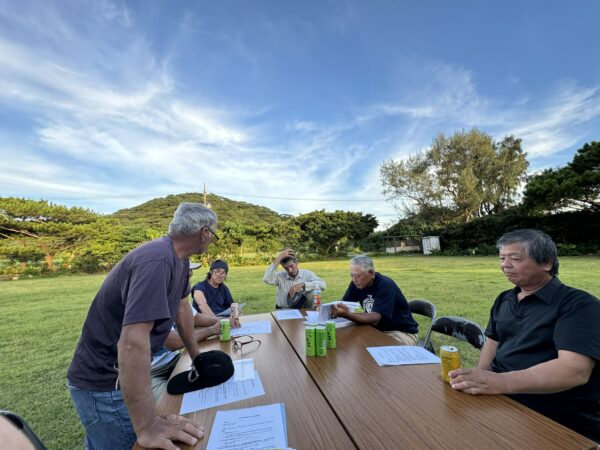
On 12 July 2024, at Kūra community hall, discussions began towards a joint charter for the Hirakubo Peninsula.
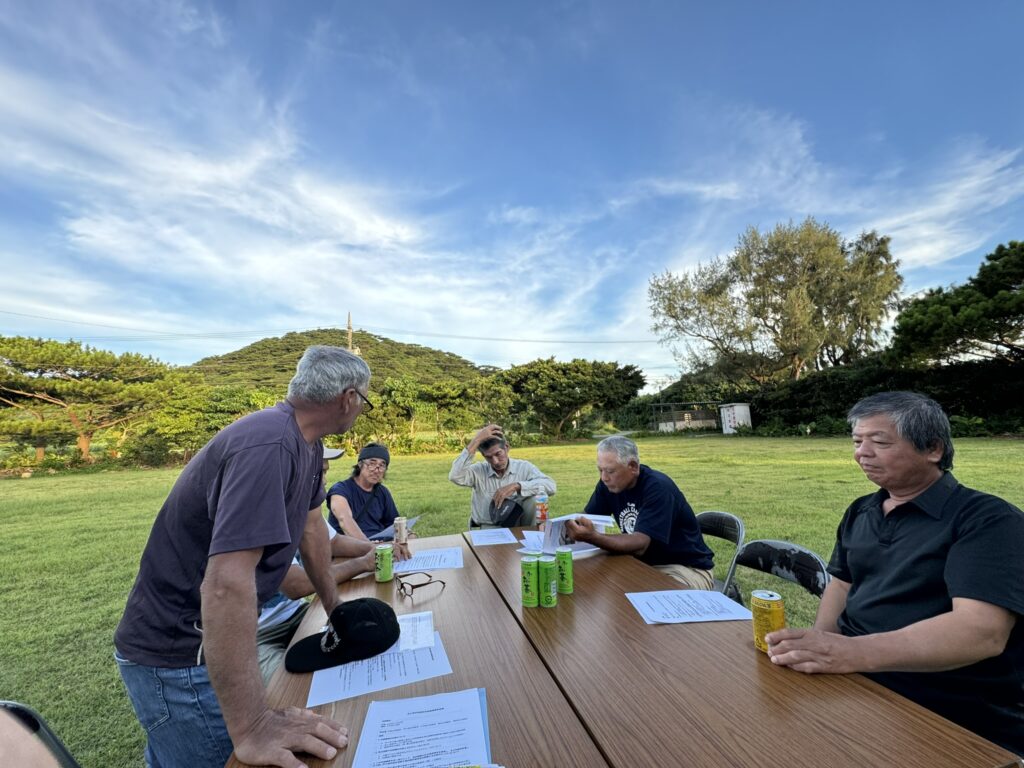
Present: Maeda, head of Kūra; Iha, head of Hirakubo; Tarō, representing Nakamura, head of Hirano; Nakazato, head of Akaishi; Higa, head of Ibaruma; Yoshida of Yoshida Sabani; and Arakaki of the Nagareboshi-no-Oka stargazing tour.
Why the five heads came together
As tourism on Ishigaki Island recovered quickly after the pandemic, a number of new operators moved in and several applications for expanded resort development were filed at the same time — on the Hirakubo Peninsula, which has not had a single large resort hotel. The meeting was called to share what each of them knew.
The future of this peninsula should be decided by those who are responsible for it
If nothing were done while outside companies moved in and development went ahead, the heads of the associations feared the peninsula would be taken in a direction that misread what is good about it — and that when the tourism boom passed, what remained would be ruins, abandoned.
A company that comes because there is money to be made in a boom will leave as easily as it came once the money stops, and move on to the next place. For the people here, who inherited this land from those before them, kept it, and mean to hand it to the next generation with its value raised, the weight of that responsibility is of another order entirely.
Beyond the boundaries of any one association
More and more visitors have been coming to the peninsula in recent years, because this is plainly a part of Ishigaki where abundant nature remains. Visitors today are not looking for manufactured resorts and famous sights; what moves them is an empty beach, a landscape with nothing built on it, a sky full of stars in a place with no artificial light. That, we think, is what the name Hirakubo stands for.
A joint charter to protect this place — and, beyond it, an ordinance
It is true that many of our predecessors worked hard to attract resort development and companies here. It is also true that hotels built across Japan at the height of the bubble-era resort boom now stand derelict, abandoned in a way that damages the landscape and lowers the value of the places around them. We can only guess at what might have been, but I believe the peninsula was fortunate to escape that wave, and that what it kept — a full sky of stars and a rich natural landscape — has become extremely valuable. The night sky in particular, helped by the peninsula’s unusual geography, is the kind of place I believe will grow more valuable still, anywhere in the world.
The reliable way to keep this environment is an ordinance. But asking for one straight away is a high bar, and the administration will not move easily.
For Ishigaki City and its assembly to begin work on an ordinance of their own, the residents of the whole peninsula have to be of one mind.
The Hirakubo Peninsula Joint Charter is how that common mind is made visible.