What this council is for
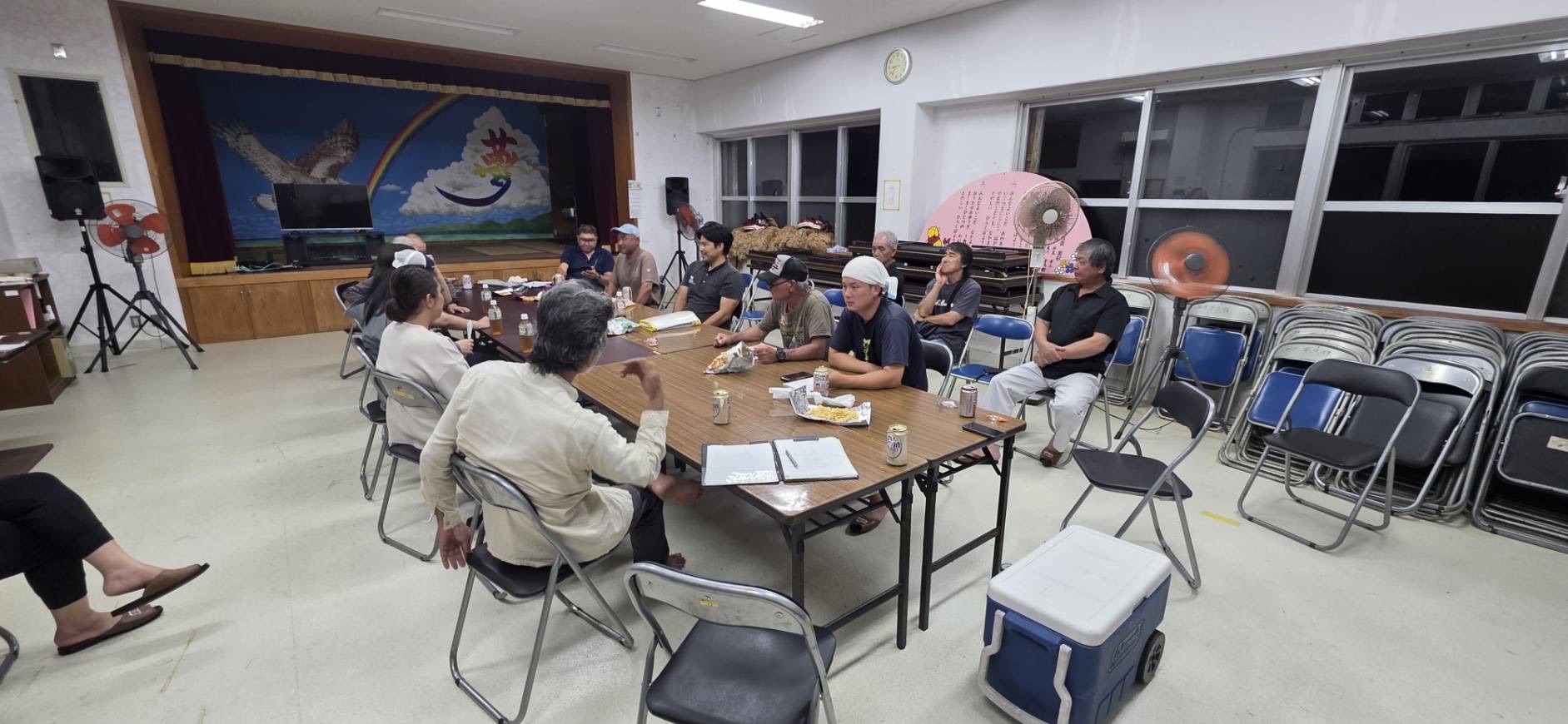
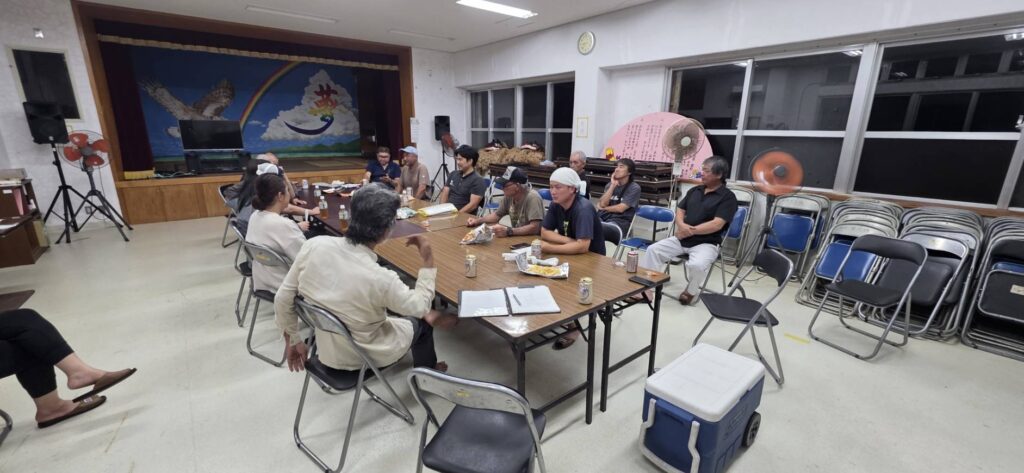
On Wednesday 6 May 2026 we held this year’s first monthly meeting, at Hirakubo community hall.
Until now the council has met mainly as directors, the heads of the community associations and the secretariat. But I had been hearing more and more people say they did not know what kind of body the council was or what it did, so from this year we changed how we work. Once a month, rotating around the five community halls of the peninsula, we hold a meeting anyone may attend. Not formal business, but a place to talk about what comes next for this area, in ordinary conversation. That is what we set out to try.
This was the first of them.
The question that came up that day
One item was the use of the management housing at the former Hirakubo school site. I wanted to hear frankly how people felt about it.
In the course of that, someone asked whether this was a matter for the council at all. Shouldn’t the council be gathering the community’s difficulties and taking them to the administration? Wasn’t going as far as the use of the site overstepping?
The matter had already been explained at the community halls several times; the board rejected it once, discussed it further, passed it on a second vote, and it is being taken forward with the approval of each association head. So I went through that history again. But listening to the discussion, I noticed a deeper issue.
People hold quite different views of what the council’s role itself is.
The council’s role differs from that of the community associations
In post-war Japan, the dominant model for a local body has long been to gather residents’ voices and take them to the administration — to petition. That is exactly what the community halls, and Gokōren — the federation of elementary and junior high school districts in the north of Ishigaki — have done: collect the difficulties and requests of residents and put them together as a petition. It is a very important function, and it continues unchanged.
But this council was set up to do something else. Not an extension or a replacement of the petition model, but a second, different function that we wanted the area to have.
The council is not a body that speaks to the administration on residents’ behalf. It is a body through which the people who live here shape their own future. Rather than collecting problems and handing them to someone else, we think through the area’s problems ourselves and act on them ourselves. Then, where we find we cannot solve something alone, we work with the administration or with others from outside. The council is designed to take things in that order.
The community associations and the council are not competitors. Their roles differ. The table sets out how.
| Community associations and Gokōren | Hirakubo Peninsula Community Council | |
|---|---|---|
| Starting point | Problems and requests | What we want to do; a vision |
| Main activity | Gathering requests and petitioning | Planning and running local projects; learning from precedents |
| Relation to the administration | Deliver requests and ask for action | Act first, and work together where that is needed |
| Scope | Each village, each district | The whole peninsula, across the five associations |
Both are necessary, and they run as a pair.
Why “act for ourselves”
I insist on that order because of my own experience.
I built a stargazing tour from nothing. At first I ran it jointly with a company in Tokyo, for whom Hirakubo was one area among many, with almost no thought for what would be left behind here. When I tried to pay people working locally enough that they would not have to commute into town, I was told to stop, because it would upset the balance with others. What I wanted was precisely a model of work that people could rely on and live from, here — and being told the opposite was a turning point.
Selling through online travel agents was the same. Large platforms are convenient, but structurally poor at conveying what is particular about a place. So from a certain point I put my effort into being able to sell directly. At the start most bookings came through the big channels; now we can generate a great deal through our own sales.
What I learned is that if an area works from its own thinking and by its own hands, it can build and run something without depending on the capital of large corporations or on their channels. Large companies of course put their own profit first — that is what a company is for — which is why it is fundamentally difficult for a region to rely on “someone big coming in to sort it out”. Not to depend, but to build.
I think the council is the same.
An administration finds it hard to move on a request alone. Only when there is a reason to move, and when the seriousness of the community is visible, can it turn towards budgets and mechanisms. Put the other way round: an area visibly acting for itself is the strongest force there is for moving an administration, or the national government.
I have never taken a subsidy for the stargazing tour. I am not against subsidies as such; I think they are something you use, if you need to, after you have acted — not something you count on from the start. Not “there is a subsidy, so let us think of a project”, but “there is something we want to do, and a subsidy covers what is missing”. That ought to be the order, and in practice it is often reversed. In the council, I want to set it the right way round.
What the school site is really asking
The management housing at the former school site is the test of exactly that.
Rather than petitioning the administration to build housing, we discuss as a community how the site can be used so that it carries to the next generation, and if necessary we build the mechanism ourselves. That the board rejected it once, discussed it further and passed it on a second vote is itself evidence that this is not a passing idea but something the area has thought about seriously.
Whether it goes well depends on what happens now. But if we flinch here and fall back on “let us ask the administration after all”, the reason for setting up this council thins out.
Protecting nature does not mean banning development
There is another concern I am often asked about.
People say the council leans too far towards conservation, or worry that once the council is involved, new development becomes impossible. There are plenty of people here who are keen on development, and some worry that the council’s existence will get in their way. I want to be clear about this too.
The council is not a conservation group. It is a body through which residents decide the future of their own area. Some of what it judges concerns how nature is protected; but just as naturally, it also concerns how life and industry here are built up, and how new undertakings are realised. Protecting and creating: the future of an area runs on both.
Protecting nature and landscape raises the value of the land
I believe that protecting the nature and the landscape of an area, as a community, raises the value of the land as a result.
The clearest example nearby is Taketomi, in the same Yaeyama Islands. In 1986 the islanders themselves adopted the Taketomi Island Charter, with five principles: do not sell, do not soil, do not disturb, do not destroy, and make use of. Red-tiled roofs, coral stone walls, white sand lanes — the islanders have led the protection of that landscape ever since.
And what happened? Taketomi is now one of the best-known destinations in Yaeyama, and its land, its lodgings and its experiences all command high value. Because residents decided to protect it, the name of the whole island rose, lifting both daily life and the local economy. Not “protecting means stopping development”, but “protecting is the ground on which development stands”.
The same pattern appears elsewhere in Japan and abroad. What Niseko, Karuizawa and Yufuin have in common — places that have held their value as destinations over a long period — is that each has a framework for protecting its landscape and environment as a community. That is why both property values and their value as destinations stay high over the long term. Where development ran ahead without such a framework, the original attraction tends to be damaged, and the value of the land itself falls.
What only Hirakubo has — a darkness rare in the world
So what does Hirakubo have?
We may not think about it much, but what survives here is a darkness at night that is becoming rare in the world. The areas of the earth from which the Milky Way is clearly visible shrink year by year. More than four-fifths of the world’s population is said to live where a real night sky can no longer be seen. This peninsula is one of the few places that still holds a resource the world is losing.
And darkness, once lost, does not return. One street light, one sign, and the sky changes for kilometres around. Just as the landscape of Taketomi has been kept by the will of its residents, the night sky of Hirakubo is an asset that cannot be kept without the will of this community.
That darkness has already begun to carry economic value. Astrotourism is a growing field worldwide, and a place with a fine night sky is itself a tourism asset. Running stargazing tours here for years, I have watched visitors catch their breath at real darkness many times over. It belongs to Hirakubo, and no other area can copy it.
Sea and landscape have their equals in neighbouring areas. But a night sky rare on a world scale is the one resource on which Hirakubo can lead outright. Protecting nature and landscape as a community is not, for this place, an abstraction or an ideal — it is a concrete economic strategy. That is how I see it.
Let me be honest about one thing. I have run stargazing tours here for years, so some may think I am saying this for my own business.
But the reason I can speak strongly about the value of darkness is not that I run a business. It is that running that business is precisely how I have watched, day after day, how rare and how fragile this resource is. I have stood beside visitors from all over the world, hundreds of times, at the moment real darkness brings them to tears. I know its value as a fact in front of me, not as an idea.
And if I were really thinking only of my own business, it would be easier not to say any of this and not to invite competition. I keep saying it because I believe the whole life of this area — my own business included — stands on nothing but the night sky being kept. Here, the interest of a business and the interest of the community coincide completely. That is what I want to convey.
The stars, the sea and the landscape of this peninsula are resources that other places are losing. Keep them as a community, and build new undertakings on top of that value. Over the long run I believe that does more for the local economy, and for the lives of the people here, than development with no framework at all.
The council should also widen what the area knows
This way of thinking may not yet be widely shared in Hirakubo. Protecting nature and developing an area are often taken to be separate things — or opposed.
That is why I want the council to be a place that widens what the area knows: to create chances to learn from precedents such as Taketomi; through study visits, workshops and shared information, to learn together how protecting something creates value; to increase the options open to us. I think that is an important part of the council’s role.
The council is not a body that stops development. It is a body in which residents themselves consider and decide what to keep and what to make new. What is needed for that is knowledge, widened together. Protecting and creating — both are judgements that rest in residents’ hands.
Towards the Hirakubo that comes next
The question raised at that meeting was not a negative one. I took it as a question asked precisely because the person cares seriously about the council.
Which is why, from here, what matters is showing what the council is for through what it does, not only in words. The monthly meetings, rotating around the five halls, are the place for that. Beginning with ordinary conversation is fine. When someone here says “I’d like to try this”, we turn it into something through the council. That is the kind of place I want it to be.
This is a body in which residents are the ones acting. If something is on your mind, do come to the next meeting.